April 23, 2026
Application Modernization Assessment: A Step-by-Step Guide

Boris Bogatin

Most modernization programs don't fail during execution. They fail during assessment, when teams score the wrong legacy applications, miss half the dependencies, and hand leadership a roadmap built on a CMDB that hasn't been accurate in years.
An application modernization assessment is the evaluation phase that decides which systems get modernized, in what order, and with what strategy. Done well, it produces a prioritized backlog and a target-state architecture that teams can ship against. Done poorly, it produces a deck. Modernization spend keeps climbing year over year, with Gartner attributing much of the double-digit IT services growth in major markets to consulting and application modernization investment, which makes getting the assessment right more consequential, not less.
This guide walks through the frameworks, the five-step workflow, the scoring criteria, and the mistakes that quietly torpedo otherwise-funded modernization efforts. It's written for CTOs, enterprise architects, and portfolio managers starting an initiative, and who want something more useful than another vendor-branded worksheet.
What Is an Application Modernization Assessment?
An application modernization assessment is a structured evaluation of an organization's application portfolio that identifies which systems to modernize, retire, retain, or rearchitect, and in what sequence. It combines business-value analysis, technical health scoring, dependency mapping, and cost modeling to produce a prioritized modernization roadmap.
The scope isn't just the apps themselves. A real assessment captures the architecture around each app: integrations, data flows, infrastructure, shared platform services, and the blast radius of a change. Scoring a legacy system without knowing that fourteen other services depend on its message queue will give you a confident, wrong recommendation.
Assessments usually run in waves. A first-pass triage scores 100 to 500 apps on a handful of attributes in days. A deeper assessment then examines 10 to 50 high-priority candidates across a dozen or more dimensions. Both feed the same roadmap.
Why Assessment Comes Before Modernization
Skipping assessment is an expensive shortcut. Teams that refactor the first app someone complained about tend to rebuild functionality that was about to be retired, rehost a legacy system whose license costs would have been cheaper to eliminate, or containerize a legacy application whose dependencies made containerization nearly impossible.
Assessment protects the business case. It tells you which applications will return the investment, which won't, and which you'd be better off leaving alone. In most portfolios, a meaningful share of applications are retirement candidates once you look honestly at usage and business value. Finding those before spending engineering hours on them is often the single largest ROI lever in the program.
Assessment vs. Application Portfolio Management
The two overlap but aren't the same. Application portfolio management (APM), closely related to Gartner's applications portfolio analysis discipline, is the ongoing practice of tracking the business, technical, and cost fitness of the application portfolio. A modernization assessment is a time-boxed decision event that consumes APM data and produces a modernization plan.
You can run an assessment without a mature APM practice. You'll just end up doing most of the portfolio work along the way. If your organization already maintains a current application portfolio catalog, the assessment mostly becomes a scoring and prioritization exercise. If it doesn't, the first three steps of the assessment are really an inventory build.
Application Modernization Assessment Frameworks
There's no single industry-standard framework. There are several, each built by a vendor or analyst for a specific context, each with blind spots. The three most commonly referenced in enterprise application modernization assessments are Gartner's TIME, AWS's 6 Rs (now 7), and cloud-readiness scoring.
Use them as lenses, not as answers. A good assessment usually blends two: one to classify applications by business disposition (keep, change, kill), and one to assign a strategy for the applications you've decided to change.
The Gartner TIME Framework (Tolerate, Invest, Migrate, Eliminate)
Gartner's TIME framework is an application rationalization model, closely aligned with the firm's broader pace-layered application strategy for portfolio categorization.
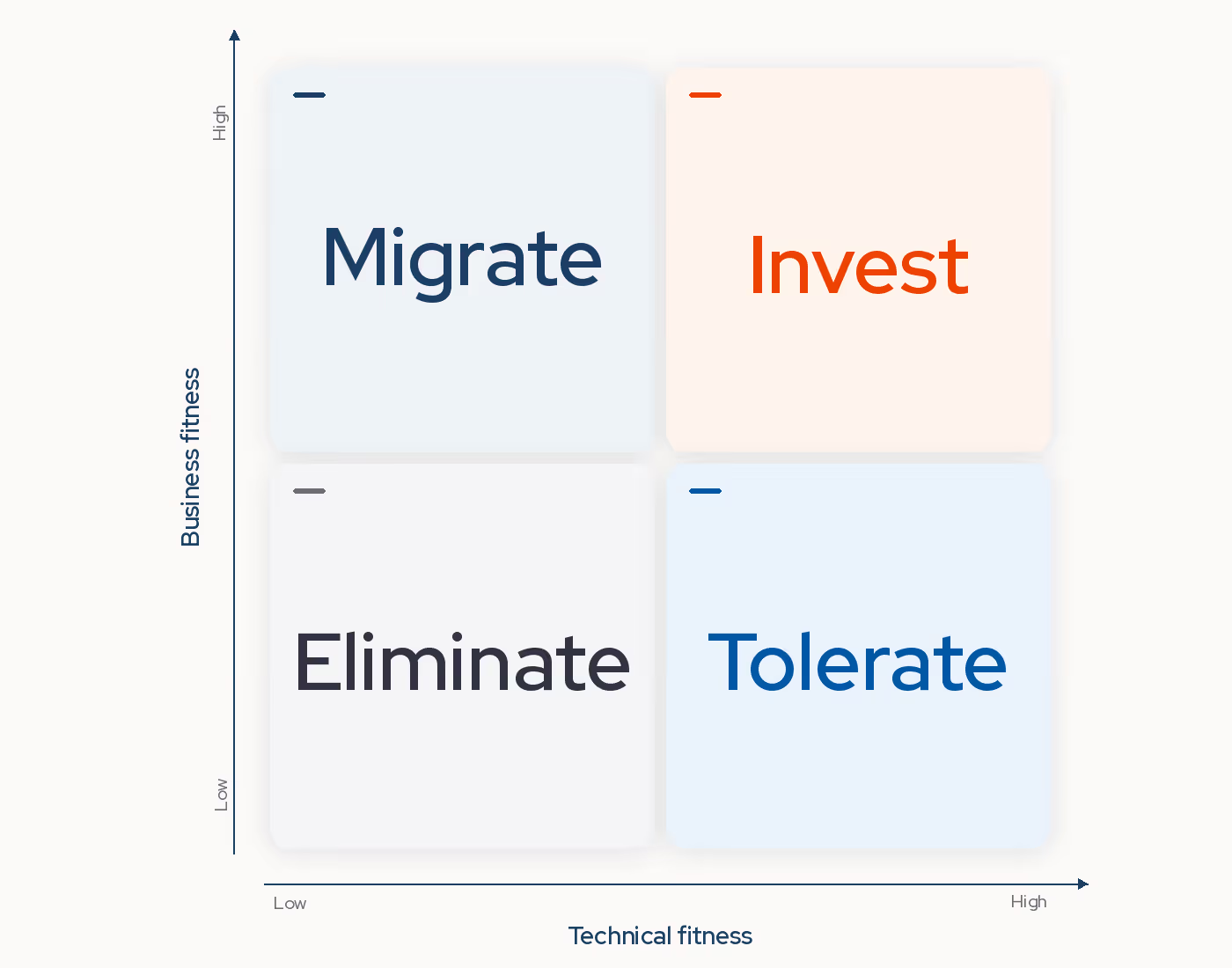
Applications are typically evaluated across business fitness (how well the app supports business outcomes) and technical fitness (how healthy the underlying system is), then classified into one of four categories:
- Invest: high business fitness, high technical fitness. These are your strategic assets. Fund them and keep them current.
- Migrate: high business fitness, low technical fitness. The business needs the app, but the underlying stack is failing. Move it to a better platform, replatform, or refactor.
- Tolerate: low business fitness, high technical fitness. The technology is fine, but the app isn't strategically important. Leave it running, don't invest more, watch for a trigger event to retire or consolidate.
- Eliminate: low business fitness, low technical fitness. Retire.
TIME is strongest as a communication tool with business stakeholders. A VP of Finance understands a four-quadrant chart much faster than a weighted rubric.
The 6 R's (Now 7 R's) Migration Strategy Model
The 6 Rs (expanded by AWS to 7 Rs with the addition of Relocate) classify applications by migration strategy rather than by business disposition.
- Rehost ("lift and shift"): move the app without modification.
- Replatform: move with minor cloud-native optimization.
- Repurchase: replace with a SaaS or commercial alternative.
- Refactor / Re-architect: rebuild to take advantage of cloud native features.
- Retire: decommission.
- Retain: leave in place, for now.
- Relocate: (in AWS's 7 Rs) move at the platform level, for example, VMware to VMware Cloud.
The 6 Rs work well downstream of a TIME-style classification. Once TIME tells you an app is in the Migrate quadrant, the 6 Rs tell you how to migrate it.
Cloud Readiness Assessment
A cloud-readiness assessment narrows the question to: can this application run in our target cloud environment, and what will it take? Criteria typically include network topology, data gravity, compliance constraints, OS and runtime compatibility, licensing portability, and dependency complexity.
Microsoft's Cloud Adoption Framework frames this as an explicit assessment phase within its Plan methodology:
"The assessment phase ensures you have full visibility into every component, dependency, and requirement before moving to Microsoft Azure."
Cloud readiness is one input to a modernization assessment. It answers feasibility, not prioritization.
TOGAF and Other Enterprise-Architecture Frameworks
For organizations already running formal enterprise architecture practices, TOGAF's Architecture Development Method addresses application baseline assessment in Phase C (Application Architecture), typically producing an Application Portfolio catalog and an Application Interaction matrix as core artifacts. These artifacts are close cousins of what a modernization assessment produces; if the EA team already maintains them, use them as the starting point rather than duplicating discovery work.
Framework Comparison
Most practical assessment templates combine TIME as the upper-layer classifier with the 6 Rs as the downstream strategy picker. If you're standardizing on a specific cloud, layer the provider's readiness model on top.
How to Run an Application Modernization Assessment
The workflow below distills what actually works across enterprise programs. It's not the only valid sequence, but skipping steps is the single most reliable way to produce a roadmap that falls apart in execution.
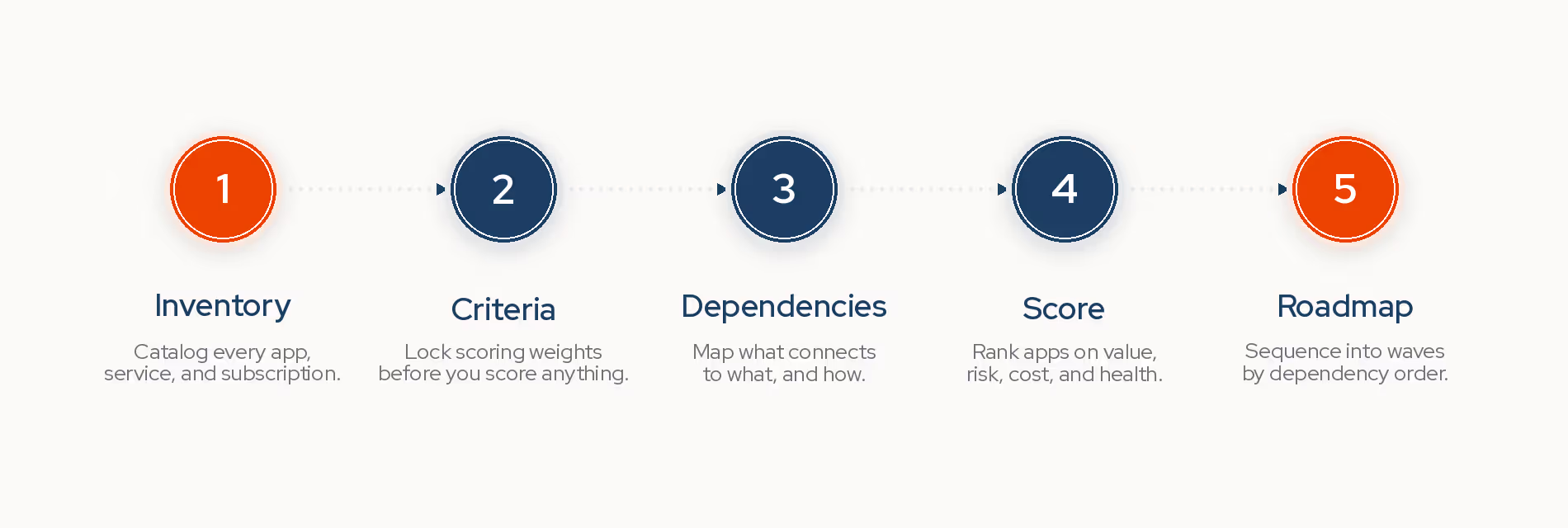
The goal of the process is to turn a scattered estate into a defensible, prioritized modernization plan.
Step 1: Build Your Application Inventory
Start with a complete, current-state list of every business application, service, and platform component running in the organization. Include shadow IT, SaaS subscriptions finance is paying for, and internal tools that never made it into the CMDB. Capture ownership, business function, hosting environment, user counts, and last-modified date.
This step almost always takes longer than planned. In most organizations, the CMDB is stale, documentation was last updated during a previous initiative, and "what's actually running in us-east-1" is a question nobody can answer confidently. Budget for discovery work. Use cloud-account scanners, network-flow data, or an architecture observability platform rather than spreadsheets and tribal knowledge.
Step 2: Define Assessment Criteria
Decide what you're going to score, on what scale, and with what weights, before you start scoring. Typical categories include business value, technical health, security and compliance risk, operational cost, and strategic alignment. Define each criterion concretely. "Business value" without a definition turns into an opinion poll.
A good criteria set has fewer than a dozen weighted factors, each scored on a 1 to 5 scale, with an explicit definition of what each score means. Lock the weights with executive sponsors before scoring begins. Changing weights mid-assessment destroys comparability.
Step 3: Map Dependencies and Integration Points
This is where most assessments collapse. Applications don't exist in isolation. They call APIs, consume queues, share databases, authenticate against common identity providers, and rely on shared infrastructure. Modernizing one application can break three others. Missing a dependency can turn a six-week replatform into a six-month outage.
Dependency mapping done manually, by interviewing app owners and consolidating architecture diagrams, is slow and incomplete. The owners know their app. They don't always know what depends on it. And diagrams drift the moment they're drawn. Automated application discovery and dependency mapping using runtime signals, network flow data, and configuration scanning produces a far more accurate picture than document-based discovery and stays current as the architecture changes.
Platforms like Catio build a live architecture digital twin of the environment so dependencies, data flows, and shared services are visible before scoring starts. That matters because assessment frameworks like TIME and the 6 Rs assume you can see the graph. When the graph is wrong, the recommendation is wrong.
Step 4: Score Each Application
Apply the criteria from Step 2 to each application in the inventory. Score objectively using the dependency data from Step 3. Apps with high blast radius (many downstream consumers) should score higher on risk even if business value is modest, because changes to them carry architectural weight the raw business-value score won't capture.
This step benefits from automation. Manual scoring of 300 apps across 10 dimensions is 3,000 judgment calls, often made by different people using different mental models. Tooling can help normalize inputs such as cost (from billing data), complexity (from static analysis), and health (from observability telemetry), providing a more consistent baseline before human review.
Step 5: Prioritize and Build a Modernization Roadmap
Rank applications by their scores, cluster them into waves, and sequence waves by dependency order. Early waves should deliver visible business outcomes and de-risk the program. Save the hardest rearchitecture work for the middle of the roadmap, after teams have shipped a few smaller wins.
The roadmap isn't a Gantt chart. It's a prioritized backlog with conditions: which team owns it, what prerequisites need to land first, what risks are open, and which metric proves success. Publish it. Revisit it quarterly. The portfolio will change, and the roadmap needs to change with it.
Key Assessment Criteria and Questions
The criteria below are the backbone of most application modernization assessment questionnaires, and they translate directly into the questions you'll put to application owners. Use them as a starting rubric and tailor weights to your objectives. A security-driven modernization weights compliance risk heavily. A cost-driven one weights TCO. A growth-driven one weights business value.
Business Value and Strategic Alignment
Key questions to anchor scoring:
- Does this application directly support a revenue-generating or strategic business capability?
- How many business users depend on it, and are they a high-value cohort?
- If this application disappeared tomorrow, what would break? (If the answer is "nothing visible," score low.)
- Is there a 3-year strategic initiative that depends on this application's evolution?
Applications that score high here are candidates for Invest or Migrate in TIME, depending on their technical fitness. Applications that score low are candidates for Retire, even if they technically run fine.
Technical Health and Complexity
- What's the state of the runtime, OS, language version, and framework version? How close to end-of-life are they?
- How much technical debt has accumulated, measured by static-analysis tooling, defect density, and change-failure rate?
- How complex is the codebase? (Lines of code alone is a weak proxy. Cyclomatic complexity and module coupling are better.)
- How observable is the application in production? Poor observability inflates modernization risk.
Security and Compliance Risk
- Does the application process regulated data (PCI, PHI, GDPR personal data, SOX-relevant financial records)?
- When was the last successful security review? Are there known, unpatched vulnerabilities?
- Does the authentication and authorization model meet current standards?
- Is the data at rest and in transit encrypted to current requirements?
A modernization assessment is often the first time security and technical teams compare notes on the application portfolio. Use it.
Operational Cost and TCO
- What's the all-in cost: infrastructure, licenses, support contracts, and engineering hours to keep it running?
- What's the cost per transaction or per user? Is that trending in the right direction?
- Are there over-provisioned resources or redundant services silently inflating the bill?
TCO is where most assessments understate the opportunity. Architecture-level cost analysis surfaces cost drivers that don't show up in cloud-provider bills alone, like duplicate services across teams, idle capacity kept "just in case," and data-transfer costs between services that shouldn't be chatting in the first place.
Common Assessment Mistakes
Most assessment failures aren't analytical. They're structural. Three patterns account for the bulk of derailed modernization efforts.
Assessing Applications in Isolation (Ignoring Dependencies)
The most common failure mode is scoring each application as if it were a standalone unit. It isn't. A well-intentioned "refactor this monolith to microservices" recommendation turns catastrophic when it surfaces, mid-project, that the monolith is the source of truth for six other legacy systems' customer data.
Architecture-level assessment, where the unit of analysis is the relationship, not just the application, is the only reliable fix. If your scoring rubric doesn't include blast radius and shared-service dependency counts, you're assessing applications, not architecture.
Relying on Manual Discovery and Stale Documentation
Diagrams in a wiki are wrong within weeks. CMDBs decay. Architecture decision records get written for the big decisions and skipped for the small ones. An application modernization strategy built on any of those alone will be a strategy for the architecture you think you have, not the one you actually have.
Automated discovery tools pull from runtime signals, configuration scans, and network flows to reconstruct the architecture as it currently exists. Coverage and freshness are dramatically better than manual alternatives. Catio's Visibility and Rationalization solution is purpose-built for this gap, turning scattered, stale artifacts into a live, unified model of the stack.
Skipping Business Context
Pure technical assessments produce technically defensible but strategically wrong answers. An app that looks perfect on every health metric may still be a retirement candidate if the business capability it supports is being retired. An app with crushing technical debt may still be an Invest, not a Migrate, if it's mission-critical and generating outsized revenue.
Business context belongs in the assessment, not as a final overlay. Ask the application owner what the app does for the business, in plain language, before scoring anything.
Application Modernization Assessment Tools
Tooling for app modernization assessments falls into three buckets: cloud-provider assessment services, traditional EA and APM platforms, and architecture visibility platforms. Most programs use more than one. Artificial intelligence has reshaped this category in the last two years, shifting scoring and dependency discovery from manual analyst work to near-real-time automation.
Cloud Provider Assessment Tools
If the target is a specific cloud, the provider almost certainly has an assessment offering. Azure Migrate, AWS Application Discovery Service, and Google Cloud Migration Center all scan existing environments, collect inventory and performance data, and produce cloud-sizing and readiness outputs. The AWS application modernization assessment approach, for example, emphasizes readiness evaluation driven by an application questionnaire that outputs a cloud migration roadmap, a target-state blueprint, and an action plan.
These tools are often free for the scanning portion, but they're cloud-specific by design and optimize toward the host provider's services. If you haven't chosen a target cloud, or you're multi-cloud, they produce recommendations biased toward the vendor that built the tool.
Architecture Visibility Platforms
Architecture visibility platforms address the piece cloud provider tools typically can't: the complete, cross-cloud picture of the architecture, independent of any one vendor's landing zone. They focus on dependency mapping, service topology, and change impact, which are exactly the inputs every assessment framework assumes you already have.
Catio is a purpose-built platform in this category. Its AI copilot for tech architecture builds a live architecture digital twin of your cloud environments, then layers data-driven recommendations on top. Two features matter most for assessments:
- Visibility and Rationalization auto-discovers applications, services, dependencies, and cost signals, replacing the spreadsheet-plus-interviews inventory step with a live model that stays current.
- Archie, Catio's conversational copilot, answers architecture questions in plain English. "What depends on this service?" and "What's the cost trend for this workload?" are exactly the kinds of questions that typically take a week of analyst work and can be answered in seconds against a live digital twin.
Vendor-neutral architecture visibility is what lets TIME, the 6 Rs, and any other framework actually work. The frameworks are only as accurate as the architecture picture you feed them.
Conclusion
An application modernization assessment decides whether the investment that follows will land or drift. The frameworks matter less than the quality of the inputs. Gartner's TIME framework, AWS's 6 Rs, and cloud-readiness models all assume an accurate, current view of your architecture, your dependencies, and your costs. Most organizations don't have that view on day one. Building it is often the single most valuable output of the assessment, regardless of framework.
Treat the assessment as the first phase of a living program rather than a one-time engagement. Portfolios change. Architectures change. The scoring you do in Q1 will look different by Q3, and the roadmap should evolve with it. An AI-powered architecture platform that keeps the visibility layer current turns the assessment from a quarterly deck into a permanent capability.
Ready to move from assessment to execution? Explore how Catio supports the full modernization roadmap from assessment to execution, or book a demo to see the architecture digital twin in action.
Frequently Asked Questions
How long does an application modernization assessment take? It varies. A first-pass triage of 100 to 300 legacy applications typically runs a few weeks when inventory data is accurate, and several months when the team has to build the inventory in parallel. Deep-dive waves usually add a few weeks each. Automated discovery and dependency mapping compress the inventory-heavy phases significantly.
Who should run the assessment? A small cross-functional team led by enterprise architecture, with representation from platform engineering, security, finance, and the business units that own the applications. External consultants can accelerate the process, but scoring decisions should stay with internal stakeholders who will own the modernization plan afterward.
What's the difference between a cloud readiness assessment and an application modernization assessment? Cloud readiness is narrower. It answers whether an application can run in a specific cloud environment and what changes are required. A modernization assessment is broader: it evaluates whether an application should be modernized at all, and if so, how and in what order. Cloud readiness is typically one input to a modernization assessment.
Do I need a framework, or can I build my own scoring rubric? Most organizations adapt an existing framework rather than inventing one. TIME and the 6 Rs are public, widely understood, and easy to explain to stakeholders. Customize the criteria and weights to match your objectives, but starting from an established application modernization framework saves weeks of internal debate.
Share this Post